 ultimate-guide
RV Storage Unit Sizing: The Complete Guide
Table of Contents
- RV Storage Unit Sizing Fundamentals
- How to Measure an RV for Storage
- RV Class Dimensions and Storage Requirements
- What Size Storage Space for a 30-Foot RV
- Indoor vs. Outdoor RV Storage
- RV Storage Cost and Size Trade-Offs
- Choosing a Storage Space Based on RV Dimensions
- Conclusion
- Frequently Asked Questions
Last Updated: October 4, 2026
RV Storage Unit Sizing Fundamentals
Choosing the right size storage space for your RV is critical, many owners assume advertised dimensions equal usable space, only to discover access problems, clearance issues, or a unit too tight for maneuvering.
RV storage unit sizing requires understanding how your vehicle's dimensions interact with the storage space's physical constraints. Your RV may fit on paper, but fitting and accessing it comfortably are two different things.
Why RV Dimensions Matter
Your RV's length, width, and height determine the minimum space needed, but accessories matter too.
You also need clearance for opening doors, maintenance access, and maneuvering.
Storage type matters: indoor units protect from weather and pests but have tighter turning radiuses, while outdoor spaces offer more maneuvering room but expose your vehicle to the elements.
Common Storage Space Dimensions
The most common RV storage sizes are 10×20, 10×30, and 10×40 units (width by depth), with some facilities offering 12×30 or 12×40 spaces for larger vehicles.
A 10×20 unit (200 sq ft) suits compact travel trailers or Class B motorhomes under 25 feet.
However, you'll lose usable space to structural supports, door frame angles, and access clearance.
How to Measure an RV for Storage
Before you reserve a storage space, you need to know your RV's actual dimensions. Most owners know the advertised length but miss critical measurements that affect storage fit.
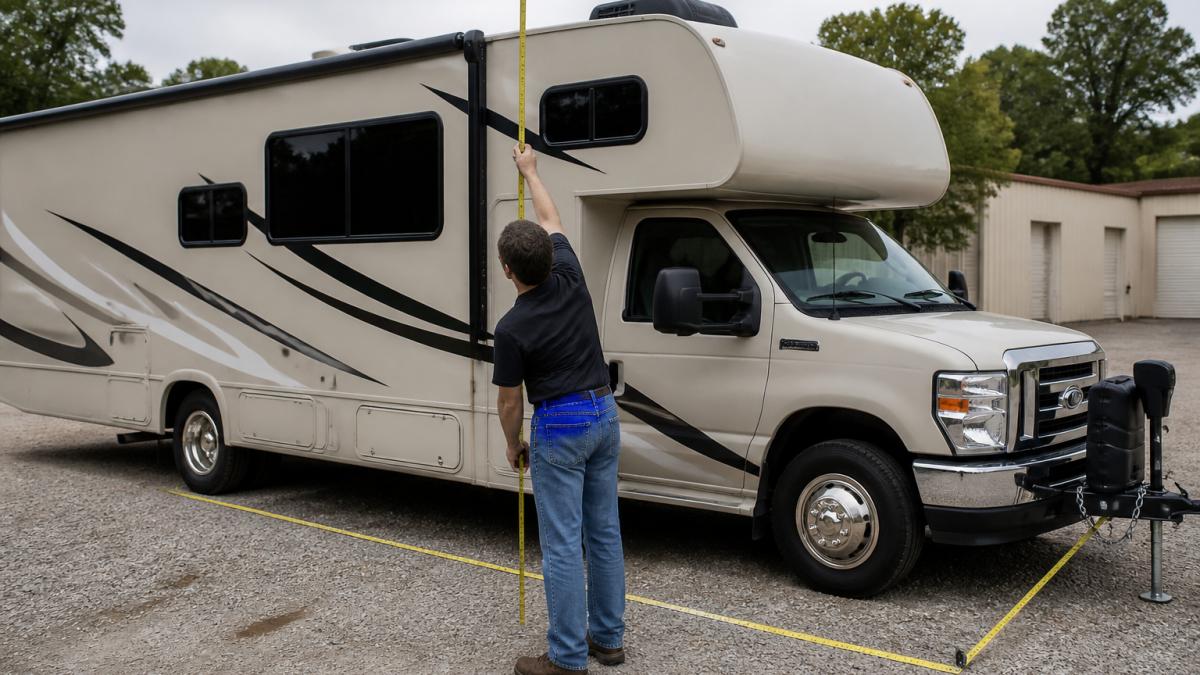
Measuring Length, Width, and Height
Measure from the very front of your RV (including bumper or cap) to the very back, don't rely on manufacturer specs. Width is the widest point of the RV body.
Write these numbers down. They're your baseline, but they're not your storage requirement yet.
Accounting for Hitch, Awning, and Roof Air Conditioner
This is where most owners go wrong. A typical hitch adds 2-3 feet to your vehicle's length. An awning extends outward when deployed, adding to width. A roof air conditioner adds 12-18 inches to height.
Measure these extensions separately and add them to your base dimensions to get your true footprint.
Measurement Checklist
Use this checklist to ensure you capture every dimension that affects storage fit:
- Length from front bumper to rear bumper (measure the actual vehicle, not the spec sheet)
- Length including hitch or pin box (if applicable)
- Width at the widest point of the RV body
RV Class Dimensions and Storage Requirements
Different classes of motorhomes have vastly different storage needs. Understanding which class your RV falls into helps you estimate the storage space you'll require.
Class A Motorhome Dimensions
Class A motorhomes typically range from 32 to 45 feet in length, 8-8.5 feet wide, and 12.5-13.5 feet tall, with some premium units exceeding 45 feet.
For a Class A motorhome, a 10×40 unit is the minimum; many owners prefer 10×50 or 12×50 spaces for comfortable maneuvering.
Class B and Class C Motorhome Dimensions
Class B motorhomes (camper vans) are typically 18-25 feet long, 7-8 feet wide, and 10-11 feet tall. They fit comfortably in a 10×20 unit with 2-3 feet of clearance on either side.
Class C motorhomes typically range from 25 to 35 feet in length, 8-8.5 feet wide, and 11-12.5 feet tall.
Travel Trailer and Fifth Wheel Sizing
Travel trailers range from 16-40 feet long, typically 8 feet wide (8.5 feet for premium models), and 10-13 feet tall.
Travel trailers under 25 feet need a 10×25 unit; 25-35 feet need 10×35; over 35 feet need 10×40 or larger.
Fifth wheels typically range from 25 to 40+ feet in length.
What Size Storage Space for a 30-Foot RV
A 30-foot RV is one of the most common sizes, and it's also one where sizing mistakes happen most often. Let's break down what you actually need.
Space Requirements with Clearance
A standard RV is 8 feet wide; plan for 10-12 feet of usable width with 1-2 feet of clearance on each side.
Most 30-foot RVs are 11-12 feet tall; add a roof air conditioner and you're at 12.5-13.5 feet.
A 30-foot RV needs a 10×35 or 10×40 unit.
Oversized Units vs. Standard Size
Oversized units (12×40 or larger) cost more but offer wider aisles, higher ceilings, and more maneuvering room.
A 10×40 unit provides 2 feet of clearance on each side of an 8-foot RV; a 12×40 unit provides 4 feet, which is more practical for regular access.
For regular access or maintenance, the extra space pays for itself in convenience and safety.
Indoor vs. Outdoor RV Storage
Your choice of storage type, indoor, covered, or outdoor, affects both the space you need and the protection your RV receives.
Indoor Enclosed Storage
Indoor enclosed storage protects your RV from weather, UV damage, and pests, the best choice for long-term storage or valuable RVs.
Indoor units are typically narrower with lower ceilings to maximize space efficiency.
Narrower dimensions require more precise vehicle sizing. Access is more restricted, you drive through hallways with turns rather than pulling straight into an open lot.
Covered Storage and Outdoor Parking Space
Covered storage protects from sun and rain at lower cost with more maneuvering room. Outdoor parking offers no weather protection but maximum flexibility.
Covered units are often 12 feet wide; outdoor spaces can be 15-20 feet wide or larger, making it easier to park and access large RVs.
Size Differences Between Storage Types
A 30-foot RV needing a 10×40 indoor unit might fit in a 10×35 covered space due to wider aisles. In an outdoor lot, it might need only 10×30 due to unlimited maneuvering room.
However, outdoor storage exposes your RV to weather, UV damage, and pests.
RV Storage Cost and Size Trade-Offs
Storage pricing is one of the biggest variables in the decision-making process, and understanding how unit size affects cost helps you make a smart choice.
How Unit Size Affects Pricing
Storage pricing scales with square footage.
For current pricing information and to understand what fits your budget, we recommend contacting Out of Site Storage directly for a quote. Pricing varies based on your specific needs, storage duration, and the type of protection you require.
Choosing the Right Size for Your Budget
If budget is your primary constraint, start with the smallest space that safely accommodates your RV plus 2-3 feet of clearance.
Consider how long you'll be storing the RV. Short-term storage (3 months or less) might justify a tighter fit to save money. Long-term storage (6 months or more) benefits from the extra space because you'll likely need to access your vehicle multiple times, and the convenience is worth the additional cost.
Choosing a Storage Space Based on RV Dimensions
Once you know your RV's dimensions and the storage type you prefer, you can make an informed decision about which unit size to reserve.
Access and Maneuverability Beyond Advertised Dimensions
Advertised dimensions describe floor space, not usable space.
Ask the facility manager about actual door opening width and structural supports.
Maneuvering room is critical. A 30-foot RV might be impossible to park safely in a dead-end 10×40 unit. A facility with wider aisles allows angled approach, making parking easier.
What to Verify Before Reserving
Before you commit to a storage space, visit the facility in person and verify these details:
- Door opening width and height: Measure the actual opening, not the advertised unit size. Some units have door frames that reduce the opening.
- Ceiling height: Confirm the ceiling height is sufficient for your RV, including the roof air conditioner.
- Approach angle: Ask about the approach to your specific unit. Can you drive straight in, or do you need to angle the vehicle? How much maneuvering space is available?
Out of Site Storage offers 24/7 access to our Howell-area facilities and can help you choose a space that's right for your vehicle and budget.
| RV Type | Typical Length | Recommended Unit Size | Minimum Height Clearance |
|---|---|---|---|
| Class B Motorhome | 18-25 ft | 10×25 | 11 ft |
| Class C Motorhome | 25-35 ft | 10×30 to 10×40 | 12-13 ft |
| Class A Motorhome | 32-45 ft | 10×40 to 10×50 | 13-14 ft |
| Travel Trailer (25-30 ft) | 25-30 ft | 10×30 to 10×35 | 12-13 ft |
| Fifth Wheel (30+ ft) | 30-40 ft | 10×40 to 10×50 | 13-14 ft |
Conclusion
Choosing the right RV storage unit sizing requires understanding your vehicle's full dimensions, including hitch, awning, roof air conditioner, and access clearance.
At Out of Site Storage, we help RV owners throughout the Howell area find storage spaces that are properly sized for their vehicles and their needs.
Frequently Asked Questions
How do I figure out what size storage unit I need for my RV?
Measure your RV's length, width, and height, then add 12 to 24 inches on all sides for clearance and maneuvering. Account for the hitch, awning, or roof air conditioner, which extend the vehicle's footprint. A 30-foot travel trailer typically needs a 10×40 space; a Class A motorhome may require 10×50 or larger. Visit the storage facility to verify the space accommodates your vehicle's actual dimensions and allows comfortable access.
Can an RV fit in a standard self-storage unit?
Most standard 10×20 or 10×30 storage units are too small for recreational vehicles. A Class C motorhome or small travel trailer may fit in a 10×30, but Class A motorhomes and larger trailers require 10×40, 10×50, or oversized spaces. Height clearance may not be an issue indoors, but length and width are the limiting factors.
What is the difference between indoor and outdoor RV storage?
Indoor enclosed storage protects your RV from weather, UV damage, and pests, making it ideal for long-term storage and premium vehicles. Covered storage offers partial weather protection at a lower cost. Outdoor parking space is the most affordable but exposes your RV to sun, rain, and temperature extremes. Indoor units typically preserve your RV's condition better over months or years of storage.
How much clearance should I leave around an RV in storage?
Plan for at least 12 to 24 inches of clearance on all sides to allow safe maneuvering during entry and exit. This space prevents damage to the RV's sides and ensures you can navigate the storage facility without hitting walls or adjacent vehicles. Tighter spaces increase the risk of scratches, dents, and difficulty accessing your vehicle, especially in indoor storage buildings.
How many square feet is a 30-foot RV?
A 30-foot RV typically measures 30 feet long by 8 feet wide, equaling 240 square feet of floor space. When you account for the hitch and add clearance for maneuvering, you'll need a storage space of approximately 10×40 feet (400 square feet) to fit comfortably. Some fifth wheels and travel trailers at 30 feet may be slightly wider, so verify your specific model's dimensions before reserving.
What should I verify with a storage facility before reserving space for my RV?
Confirm the unit's interior dimensions, ceiling height, and door width to ensure your RV fits. Ask about drive-in access, turnaround room, and whether the facility can accommodate your hitch and awning. Verify 24/7 access if you need emergency retrieval, check security features, and ask about climate control or pest management if you're storing long-term. Visit in person to walk the space and test maneuvering if possible.
How do RV storage costs compare between unit sizes?
Storage pricing depends on unit size, location, storage type (indoor, covered, or outdoor), and rental duration. Larger units cost more than smaller units. Month-to-month rentals may have higher per-month rates than annual contracts. Contact your local storage facility directly for current pricing and any discounts for longer commitments.